

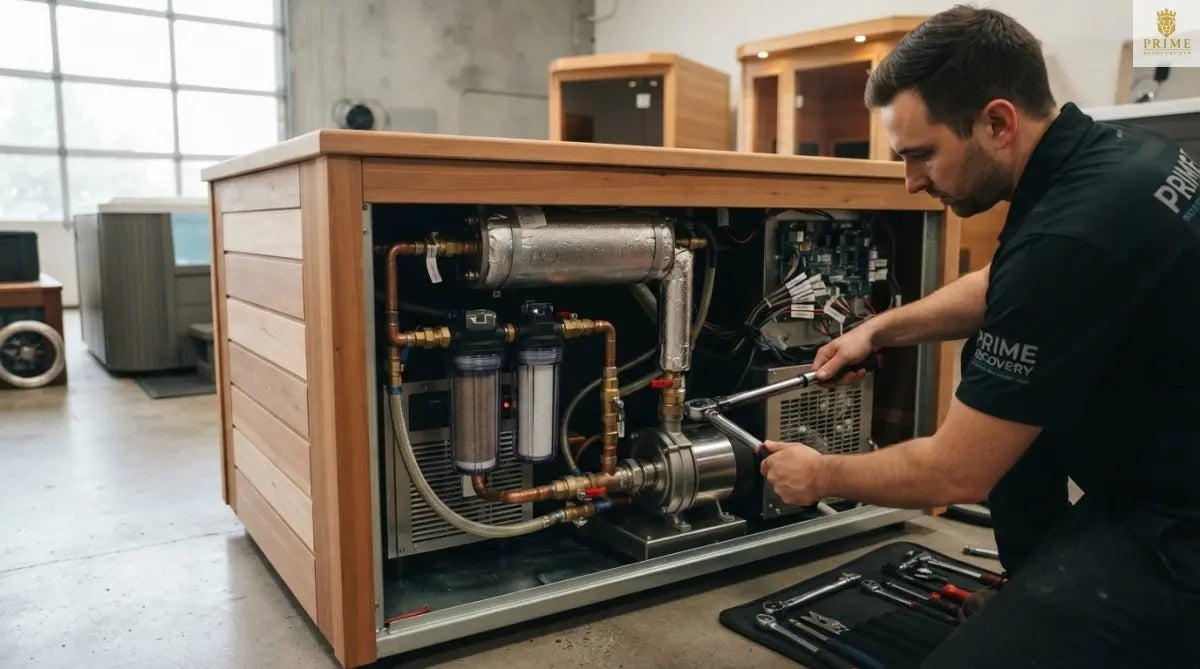
Why Premium Cold Plunges Cost More: Engineering & Value
Table of Contents
- Why Premium Cold Plunges Cost More: The Engineering Behind the Price
- Materials and Build Quality: Durability That Justifies the Investment
- Advanced Cooling Technology: Chiller Units and Temperature Control
- Cold Plunge Chiller vs Ice Cost: Understanding the Long-Term Economics
- Insulation and Thermal Efficiency: Why Heat Loss Matters
- Cold Plunge Features Explained: Water Filtration, Sanitation, and Control Systems
- Cold Plunge Maintenance Cost: Hidden Operational Expenses Breakdown
- Expensive Cold Plunge Benefits: What You Actually Gain From Premium Models
Why Premium Cold Plunges Cost More: Engineering & Value
Last Updated: July 26, 2026
Understanding why premium cold plunges cost more requires looking beyond the sticker price to the engineering, materials, and long-term operational costs that separate a basic ice bath from a sophisticated recovery system. The real cost drivers involve precision temperature control, durability standards, and features that compound in value over years of daily use.
Materials and Build Quality: Durability That Justifies the Investment
The foundation of any premium cold plunge is the materials used in construction. Marine-grade or surgical-grade stainless steel costs significantly more than standard steel or fiberglass alternatives, but delivers measurable durability advantages that compound over time.
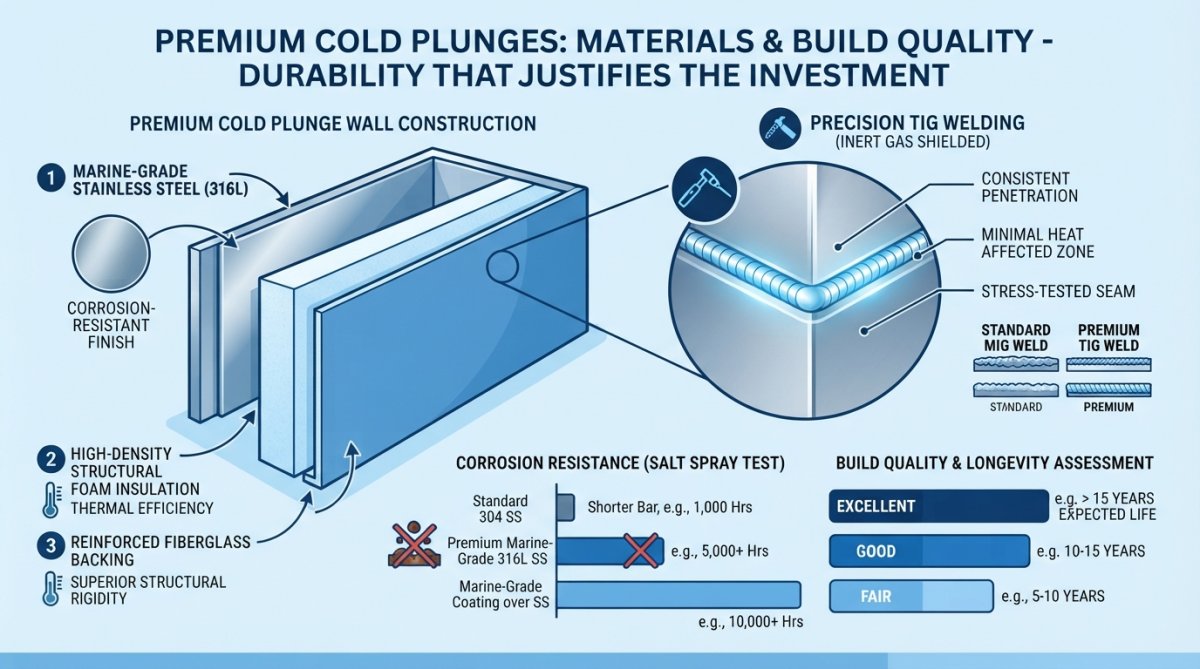
Standard construction materials corrode and require replacement within 3-5 years of regular use. Marine-grade stainless steel resists chlorine exposure, mineral buildup, and electrochemical degradation that occurs in constantly recirculated water. The material costs add 40-60% to manufacturing expenses but translate into a plunge that remains structurally sound for 10-15 years.
The difference between 304 and 316 stainless steel matters significantly. 316 grade includes molybdenum, providing superior resistance to pitting and crevice corrosion, exactly the conditions inside a cold plunge. Premium welding uses certified welders and multi-pass techniques that create stronger seams, while budget manufacturers use single-pass welds prone to micro-fractures under thermal stress.
Advanced Cooling Technology: Chiller Units and Temperature Control
Premium cold plunges use integrated chiller units that maintain precise temperature within 1-2 degrees Fahrenheit, unlike standard ice baths that are labor-intensive and inconsistent.
Variable-capacity compressors adjust output based on current water temperature rather than cycling at full power. This reduces energy consumption by 30-40% compared to fixed-capacity units while delivering faster temperature recovery. A premium chiller cooling 300 gallons from 68°F to 39°F in 45 minutes uses less electricity than a budget unit taking 90 minutes, saving $200-400 annually depending on local rates and usage frequency.
Temperature stability matters for recovery protocols. Elite athletes follow specific targets: 50-59°F for general recovery, 39-50°F for inflammation reduction, 35-39°F for advanced protocols. Premium chillers hold these targets consistently; budget ice-based systems drift upward throughout sessions, making protocol adherence impossible.
Cold Plunge Chiller vs Ice Cost: Understanding the Long-Term Economics
An ice-based plunge costs less upfront but requires consistent ice purchases. A typical household plunge needs 40-80 pounds of ice per session. At bulk ice prices, that's roughly $3-8 per session. For someone using a cold plunge 4-5 times weekly, annual ice costs reach $600-2,000. Over ten years, that's $6,000-20,000 in ice alone.
A premium chiller eliminates ice purchases entirely. Electricity costs for running a chiller 4-5 times weekly average $40-80 monthly, or $480-960 annually. Over ten years, that's $4,800-9,600 in electricity, roughly half the cost of continuous ice purchases for most users. Periodic maintenance (filter changes, compressor servicing) costs $200-400 annually but still totals less than ice costs.
The operational simplicity carries undervalued benefits: no ice storage space required, no weekly ice runs, no temperature management during sessions, no risk of overflow. This convenience translates into more consistent usage patterns and better recovery outcomes.
Insulation and Thermal Efficiency: Why Heat Loss Matters
Thermal insulation quality determines how long a cold plunge maintains target temperature between sessions and how much energy the chiller must expend. Premium cold plunges typically use 2-4 inches of closed-cell foam insulation, while budget models use 0.5-1 inch or rely on shell material alone.
A premium plunge loses 2-3 degrees Fahrenheit per hour when idle; a budget plunge loses 5-8 degrees per hour. This heat loss difference directly impacts chiller runtime. Superior insulation can reduce total electricity costs by 25-35% over five years while extending compressor lifespan by 2-3 years.
Premium systems combine stainless interior surfaces with thick foam exterior layers. Water circulation design also affects efficiency, premium systems use insulated piping that minimizes heat loss during filtration cycles, reducing heat loss by 40-50% compared to poorly designed alternatives.
Cold Plunge Features Explained: Water Filtration, Sanitation, and Control Systems
Water management systems separate premium cold plunges from basic ice baths. Water clarity, chemical balance, and microbial control directly impact both safety and user experience.
Premium cold plunges integrate multi-stage filtration systems that remove particles down to 5-10 microns, preventing cloudiness and extending time between full water changes from weekly to monthly. These systems cost $400-800 to install but save hundreds of dollars annually in chemical and water costs.
Ozone sanitation technology eliminates the need for heavy chlorination. Ozone generators inject ozone gas into the circulation loop, oxidizing bacteria and organic compounds without leaving residual chemicals. Ozone systems reduce chlorine requirements by 70-80% and cost $1,200-2,000 for quality installation.
UV sterilization systems kill microorganisms as water passes through, providing continuous disinfection without chemical additives. Smart control systems allow temperature pre-setting, scheduling, and smartphone app monitoring, adding $300-600 but eliminating guesswork and ensuring consistent conditions.
Cold Plunge Maintenance Cost: Hidden Operational Expenses Breakdown
Premium cold plunge maintenance is more predictable and generally less expensive than budget alternatives. Filter cartridges require replacement every 3-4 months with regular use, costing $60-120 per cartridge ($180-480 annually). Compressor servicing every 2-3 years costs $200-400 per visit ($70-150 annually averaged).
Water testing and chemical balance requires monthly attention in chlorine systems, less frequently in ozone-based systems. A premium system with ozone reduces this burden significantly. Complete water changes occur 2-3 times annually for premium systems versus weekly for budget systems, costing $50-100 annually versus $500-1,200.
| Maintenance Item | Premium System | Budget System | Annual Cost Difference |
|---|---|---|---|
| Filter replacement | $180-480 | $0 (full changes instead) | Premium slightly higher |
| Water changes | $50-100 | $500-1,200 | Budget significantly higher |
| Compressor service | $70-150 | N/A | Premium only |
| Chemical testing | $120-240 | $0 (less relevant) | Premium higher |
| Total Annual | $420-970 | $500-1,200 | Comparable or Premium lower |
The labor cost of maintenance often exceeds material cost. A budget system requiring weekly water drains demands 2-3 hours monthly. A premium system requiring quarterly drains demands 2-3 hours annually. Over five years, the time savings justify premium pricing for anyone whose time has meaningful value.
Expensive Cold Plunge Benefits: What You Actually Gain From Premium Models
Premium pricing translates into measurable benefits that compound over years of ownership.
Post-workout recovery optimization enables users to follow established cold exposure protocols with precision. Research shows that temperature consistency matters, protocols developed at 39°F produce different outcomes at 45°F. Premium systems enable protocol adherence; budget systems force temperature compromise.
User experience quality improves substantially: no ice smell, no floating debris, no temperature drift, no water cloudiness. This drives consistent usage, users who enjoy the experience use it more frequently.
Longevity and warranty protection provide financial security. Premium manufacturers typically offer 5-10 year warranties on the basin and 3-5 years on the chiller. Budget manufacturers offer 1-2 year warranties or none.
Resale value preservation matters for future moves or upgrades. A premium cold plunge retains 40-60% of purchase value after 5 years; budget models retain 10-20%. For a $5,000 premium plunge versus a $1,500 budget model, the resale value difference can be $2,000-3,000 after five years.
Aesthetic integration represents an underestimated benefit. Premium cold plunges integrate into sophisticated home environments without looking out of place, while budget models have obvious "budget equipment" appearance.
According to research from the American College of Sports Medicine, cold water immersion protocols require precise temperature control to produce consistent physiological adaptations, underscoring why premium temperature management systems deliver measurable value.
The True Cost Drivers You Need to Understand
Premium cold plunge pricing reflects genuine engineering investments. When you pay more, you're funding superior materials lasting 2-3x longer, precision temperature control enabling consistent protocols, advanced sanitation systems eliminating chemical reliance, integrated smart features optimizing cooling schedules, warranty protection, and aesthetic design.
For casual users (1-2 sessions monthly), an ice-based system may suffice. For serious users (4+ sessions weekly) committed to consistent cold exposure protocols, a premium system pays for itself within 5-7 years through electricity savings, reduced maintenance, and eliminated ice costs, before accounting for consistent user experience and protocol adherence.
Premium cold plunges cost more because they're engineered to perform consistently, last decades, and integrate into sophisticated home environments. The price difference reflects real performance gaps, not brand markup.
At Prime Recovery Den, we've curated a selection of premium cold plunges designed with precision temperature control, marine-grade stainless steel construction, and integrated sanitation systems that eliminate guesswork from your recovery protocol. Our models feature advanced chiller units maintaining temperature within 1-2 degrees, ozone and UV sanitation technology, and smartphone app controls for remote scheduling. Transform your recovery practice with equipment engineered for consistency and longevity, explore our full collection and discover how premium design elevates your personal wellness sanctuary.
Frequently Asked Questions
What features increase the cost of a premium cold plunge?
Premium cold plunges cost more due to several key factors: advanced chiller units with precise temperature control, marine-grade stainless steel construction, high-efficiency insulation systems, integrated water filtration with ozone sanitation and UV sterilization, smart control systems, and professional-grade compressors. Each component adds to the total cost of ownership while improving durability, energy efficiency, and user experience. Budget models skip these features, resulting in higher long-term operational costs and shorter lifespans.
How does cold plunge chiller vs ice cost compare over five years?
A premium chiller-equipped cold plunge has higher upfront costs but lower operational expenses. Ice-based systems require continuous ice purchases, which accumulate significantly over time. Chiller units consume electricity but eliminate recurring ice costs and offer superior temperature consistency for post-workout recovery. Premium models with efficient compressors and insulation reduce energy consumption compared to budget alternatives. Total cost of ownership favors premium chillers when calculated across five years, especially if you use your cold plunge regularly for cryotherapy and cold water immersion.
What are the hidden operational costs of owning a cold plunge?
Beyond electricity, cold plunge maintenance costs include water filtration replacement (typically every 6-12 months), chemical balancing supplies, ozone or UV sanitation system upkeep, compressor servicing, and potential repairs. Premium models with quality construction minimize unexpected failures and warranty claims. Budget cold plunges often require more frequent repairs and component replacements, driving hidden costs higher. Professional installation and plumbing setup add to initial investment but prevent costly water damage and ensure electrical safety certification compliance.
Are expensive cold plunges worth the investment for home recovery?
Premium cold plunges justify their cost through superior build quality, advanced features like precise temperature control and automated sanitation, extended warranties, and better long-term value. They deliver optimized post-workout recovery through consistent cold water immersion and cryotherapy benefits. Premium models retain resale value better, offer reliable customer support, and demonstrate manufacturing transparency. If you prioritize durability, user experience, and peace of mind over minimum cost, a premium cold plunge provides significant value, especially when amortized over 10+ years of regular use.

Leave a comment
This site is protected by hCaptcha and the hCaptcha Privacy Policy and Terms of Service apply.