

How to Choose the Right Cold Plunge Size for Your Home
Table of Contents
- Why Cold Plunge Size Determines Your Recovery Experience
- Internal Dimensions vs. External Footprint: What Actually Matters
- Cold Plunge Dimensions for Tall Users: Height Accommodation Guide
- Best Cold Plunge for Small Spaces: Space Optimization Strategies
- Cold Plunge Water Capacity Requirements and Cooling Efficiency
- Floor Load, Installation, and Ergonomic Setup Considerations
- Matching Cold Plunge Size to Your Recovery Goals and Budget
- Conclusion: Making Your Final Cold Plunge Size Decision
- Frequently Asked Questions
Last Updated: October 3, 2026
Why Cold Plunge Size Determines Your Recovery Experience
Cold plunge size decides whether you stick with cold therapy or abandon it after two weeks. Too small, and your shoulders stay dry.

Most sizing guides miss this: the tub that fits your body isn't always the tub that fits your space, floor, or budget.
Cold exposure triggers a real physiological response, including research on cold water immersion and the vagus nerve, but that response depends on getting your body properly submerged.
Internal Dimensions vs. External Footprint: What Actually Matters
Internal dimensions decide your comfort. External footprint decides whether the tub fits through your gate.
Internal dimensions are the usable space inside the tub, measured wall to wall and floor to rim. External footprint is the total space the tub occupies, including insulation, frame, and chiller clearance.
Most buyers check one and forget the other. Then the tub arrives and won't fit the patio door.
Measure these four numbers before shopping:
- Interior length and width at the widest point
- Interior depth from floor to rim
- Exterior length, width, and height
Add at least 6 inches of clearance on every side for stepping in, draining, and reaching the filter.
Measuring Submersion Depth and Shoulder Coverage
Submersion depth is the distance from the tub floor to the water line, not the rim.
For full recovery benefits, aim for water that reaches your shoulders while seated or standing upright. That means roughly 34 inches or more of interior depth for most adults.
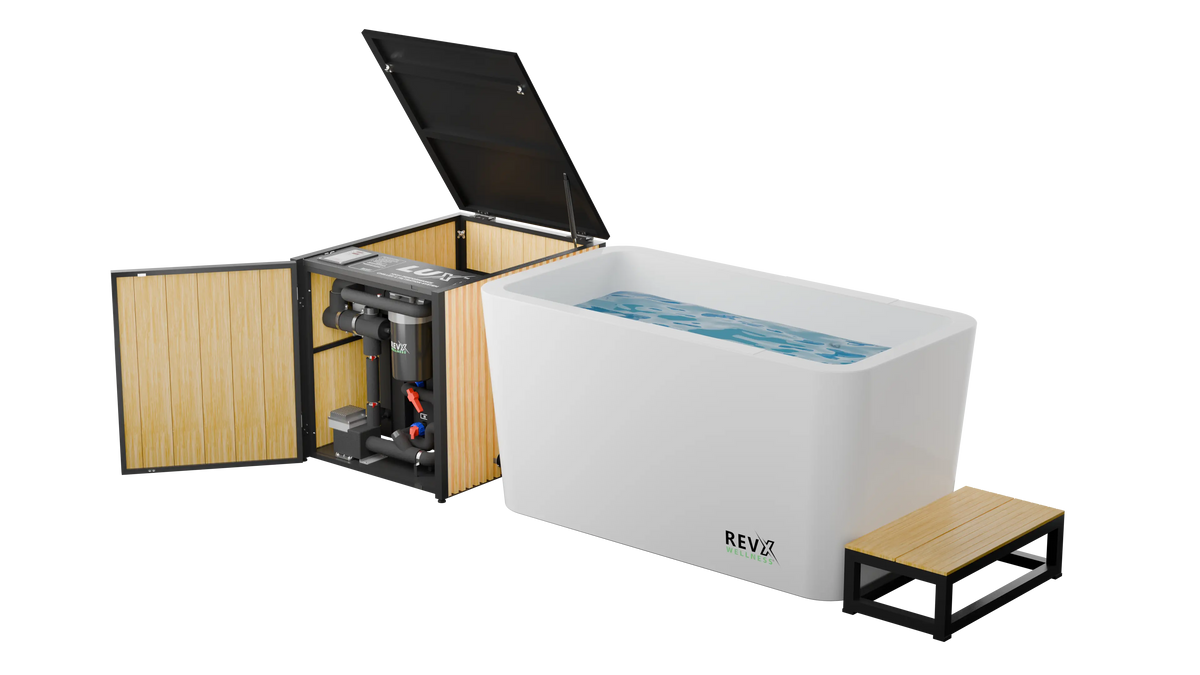
Our RevX Acrylic X Tub Cold Plunge runs over 34 inches deep, which allows full above-the-shoulder submersion in an upright position.
Cold Plunge Dimensions for Tall Users: Height Accommodation Guide
If you're over 6 feet, standard tubs will let you down. Most inflatables top out around 26 to 30 inches deep, leaving tall users hunched with cold shoulders.
Tall users should prioritize three specs:
- Interior depth of 34 inches or more
- Interior length that lets you extend your legs
- A step-in height you can safely manage
The trade-off is footprint: deeper tubs take more water and floor space.
For very tall users, an upright plunge beats a seated soak, shoulder coverage without folding your knees into your chest.
Best Cold Plunge for Small Spaces: Space Optimization Strategies
The best cold plunge for small spaces isn't the smallest tub, it's the tub that lets you achieve full shoulder submersion in your best recovery posture without sacrificing floor space you don't have. Most guides stop at "pick a round tub." The real decision is a three-way trade between footprint, posture, and water volume.

Start With Posture, Not Dimensions
There are two viable plunge postures, and each demands a different tub shape:
- Seated, legs extended: You need interior length roughly equal to your height minus a few inches, plus enough depth that the water line crosses your shoulders. This is the most common posture for rectangular and oval tubs.
- Seated, knees up (fetal-style): You need far less length but more depth, because your torso sits more upright. Round tubs and compact squares favor this posture.
- Standing upright: You need the deepest interior of all, typically 34 inches or more of water depth, but the smallest footprint of any full-submersion option. This is the posture most small-space buyers overlook, and it is often the best fit for a narrow garage bay or balcony corner.
A common pattern: a 48-inch round tub with 34 inches of interior depth delivers full shoulder coverage upright or knees-up while occupying under a 4-foot square. A 60-inch rectangular tub in the same corner forces a legs-extended posture and eats roughly twice the footprint.
The Footprint Math Most Buyers Skip
External footprint isn't the tub alone. Add:
- Chiller unit width plus 6 inches of ventilation clearance on the exhaust side
- Hose routing space, plan for at least 3 feet of slack so you can move the chiller for cleaning
- A dry standing zone at the entry point, ideally 24 inches deep, so you are not stepping out onto a wet, slick surface
A tub advertised as a 48-inch footprint can require a 6-foot by 4-foot clear zone once the chiller and entry pad are included. Measure that combined rectangle, not the tub alone.
Small-Space Strategies That Actually Work
- Choose round over rectangular when width is the binding constraint; round shapes waste corners but fit narrow patios and garage bays far better.
- Mount the chiller on a locking caster cart so it can be rolled out of the walkway between sessions.
- Route hoses along walls and use a drip tray under the chiller to protect flooring.
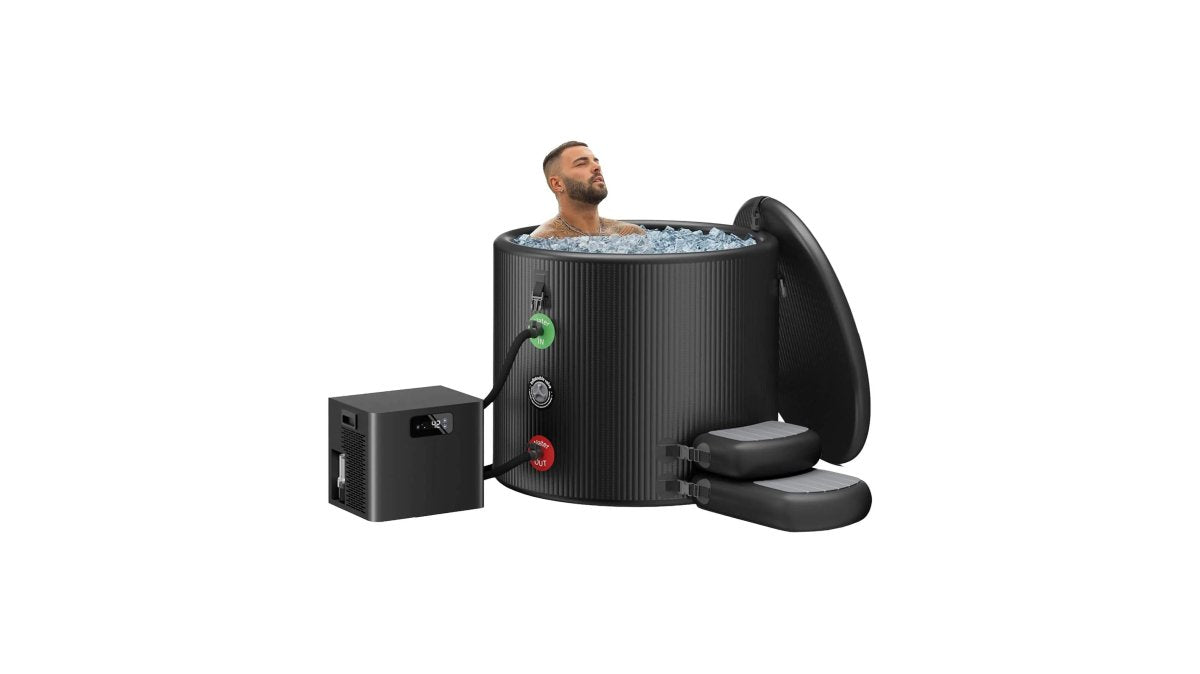
Our FCP Premium XL Cold Plunge Tub Kit is built for exactly this constraint. The 120-gallon round tub pairs with a 1/3 HP chiller, insulated lid, and travel bag, deflating into a compact bundle for a balcony, garage corner, or car trunk. Owners describe it as feeling like a private recovery corner rather than equipment bolted to the yard, the ritual without surrendering the space.
When Small Space Forces a Compromise
If your only viable spot is under 4 feet wide, you have two honest options: a knees-up posture in a deep round tub, or a shorter tub with partial shoulder coverage. Don't buy a long rectangular tub that fits the floor but leaves you hunched with cold shoulders, that's the setup people abandon first. Match posture to space, then tub to posture.
RevX Acrylic X Tub Cold Plunge + LUX 1.5HP Chiller – 34"+ Deep, 3" Insulated →
Cold Plunge Water Capacity Requirements and Cooling Efficiency
Water capacity and cooling efficiency move together. More gallons means more thermal mass, holds cold longer, but takes more energy to chill initially.
A 1/3 HP chiller handles roughly 100 to 150 gallons comfortably. A 1.5 HP unit drives larger volumes and holds tighter temperature control.
Here's the practical math:
| Tub Capacity | Chiller Size | Best For |
|---|---|---|
| 100-120 gal | 1/3 HP | One user, indoor or covered patio |
| 120-150 gal | 1/3 HP | One user, room to stretch |
| 150+ gal | 1.5 HP | Tall users, faster cooldown, tighter temps |
Thicker insulation lowers your running costs. The FCP Premium 2XL Cold Plunge Tub Kit uses 7-layer reinforced insulation and a 148-gallon oval tub, giving you full-body immersion with room to stretch out.

Floor Load, Installation, and Ergonomic Setup Considerations
Most sizing guides skip this section entirely, and it's the one that can cost you a deck, a ceiling, or a hospital visit. Water weighs about 8.3 pounds per gallon, compounding fast once you add the shell, chiller, and a human body.
Run the Real Load Numbers Before You Place Anything
A 148-gallon tub holds roughly 1,230 pounds of water. Add a 100-pound shell, 40-pound chiller, and 180-pound adult, and you're asking a floor to carry about 1,550 pounds concentrated into 4 to 5 square feet.
- Concrete patio or garage slab: Generally handles a filled tub without modification. Confirm the slab is not a thin cosmetic overlay over a void.
- Ground-level wood deck: Most residential decks are designed for roughly 40 to 50 pounds per square foot of live load. A filled tub can exceed 100 pounds per square foot in its footprint. Bracing, additional footings, or a structural review is often required.
- Balcony or upper level: Treat this as a structural engineering question, not a shopping question. Do not place a filled tub on an upper-level deck without a professional assessment.
A common pattern: buyers check the dry shipping weight, see a manageable number, and assume the floor is fine. Dry weight tells you nothing about the installed load.
Installation: Power, Water, and Drainage
Three utilities decide where a tub can actually live:
- Power: Chillers draw meaningful current. Confirm the circuit can carry the chiller's rated amperage and that an outlet sits within the cord's reach, extension cords on a wet patio are a hazard, not a solution.
- Fill source: A hose bib within reach saves you hauling buckets. A 120-gallon tub takes roughly 15 to 20 minutes to fill at typical residential pressure.
- Drain path: Gravity drain valves need a downhill route. If your only option is a pump, budget for one and for the time it adds to every water change.
Ergonomic Setup: The Part That Decides Whether You Keep Plunging
Entry and exit safety is where performance-focused guides go quiet, and where most injuries and abandoned habits originate.
- Step-in height: A rim more than 20 inches off the ground forces a lunge that gets riskier when you are cold, wet, and barefoot. Built-in steps or a stable stool change the daily experience entirely.
- Non-slip surfaces: Wet acrylic and fiberglass are slick. Look for textured floors or add a mat rated for wet areas.
- Handhold: A grab rail at the entry point is the single cheapest safety upgrade you can make.
Our Premium 1-Person ThermoWood Cold Plunge Tub arrives fully assembled with sturdy stairs and a 1-inch drain valve, and needs no electricity, place it anywhere in the yard without running power or trenching a line. Owners describe the entry as feeling secure rather than precarious, which turns a plunge from a dare into a daily ritual you look forward to.

Matching Cold Plunge Size to Your Recovery Goals and Budget
Your recovery goals set the size floor. Occasional post-workout plunges need less depth than daily contrast therapy.
Match your situation to the right tub:
- Casual recovery, tight space: round inflatable, 100-120 gallons
- Daily use, average height: oval tub, 120-150 gallons
- Tall user, full submersion: deep acrylic or wood tub, 34+ inches
Budget shapes the material. Inflatables cost least and move easily. Acrylic and ThermoWood cost more but last longer and hold temperature better.
Where the extra money goes is insulation, chiller quality, and build. Those three things decide how often you actually plunge.
Conclusion: Making Your Final Cold Plunge Size Decision
Getting the size wrong is the most common and most expensive mistake in home cold therapy.
At Prime Recovery Den, we built our cold plunge collection around that problem.
Get started with Prime Recovery Den and turn a corner of your home into the restorative retreat you'll actually use.
CDC guidance on water safety and recreational water illness
National Institute on Aging information on safe physical activity for older adults
Frequently Asked Questions
Do I need a larger cold plunge if I am over six feet tall?
Yes. Standard cold plunge tubs often measure 30 to 32 inches deep, which leaves taller users with only chest-deep submersion. A tub with 34 inches or more of internal depth lets you stand upright with full above-the-shoulder coverage. The RevX Acrylic X Tub offers over 34 inches of depth, making it a strong fit for users over six feet who want complete full-body immersion without crouching or bending.
How much floor space should I allocate for a cold plunge setup?
Plan for the tub's external footprint plus at least 18 to 24 inches of clearance on all sides for entry, exit, and maintenance access. If you are using a chiller unit, add another 12 to 18 inches behind or beside the tub for the chiller and hose connections. For compact spaces, an inflatable round tub like the FCP Premium XL, which includes a 1/3 HP chiller and travel bag, can fit on a small patio or in a garage corner without permanent installation.
How does the volume of a cold plunge affect cooling efficiency?
More water takes longer to cool and requires a more powerful chiller to hold a steady temperature. A 120-gallon tub paired with a 1/3 HP chiller reaches and maintains cold temperatures efficiently for solo sessions. A 148-gallon oval tub offers more room to stretch but may need longer initial cooling time. Insulation matters too: 5-layer or 7-layer insulation and an insulated lid reduce heat gain so the chiller runs less often.
Can a compact cold plunge provide the same benefits as a full-sized tub?
A compact tub can deliver the same cold exposure benefits if it allows full-body immersion in a comfortable posture. The key is matching the tub's internal depth and shape to your height and preferred sitting or standing position. An ergonomic round or oval design maximizes soak depth in a smaller footprint. If the water covers your shoulders and you can relax without your knees breaking the surface, the size is working for you.

Leave a comment
This site is protected by hCaptcha and the hCaptcha Privacy Policy and Terms of Service apply.