

Are Home Saunas Worth It for Stress Relief? 2026 Review
Table of Contents
- The Real Cost of a Home Sauna vs. a Gym Membership
- How Home Saunas Affect Stress and Cortisol Levels
- How Long to Stay in a Sauna for Stress Relief
- Best Practices for Home Sauna Use
- Do You Need Professional Sauna Installation Services Near Me?
- Top Home Sauna Models for Stress Relief
- Common Concerns and Safety Precautions
- Conclusion: Is a Home Sauna Right for You?
- Frequently Asked Questions
Last Updated: September 12, 2026
The Real Cost of a Home Sauna vs. a Gym Membership
If you're asking whether home saunas are worth it for stress relief, the math only works when you compare a sauna to what you actually spend chasing calm. A gym membership buys access to equipment you drive to, wait for, and share. A sauna buys you a room in your own house that exists for one purpose: making you slow down.
This guide from Prime Recovery Den walks through the numbers, the physiology, and the decisions that separate a sauna you use five times a week from one that becomes an expensive cedar closet.
The financial case is less about sticker price than the recurring cost of alternatives. Most people underestimate what they spend on recovery: massages, spa day passes, boutique classes with a sauna in the locker room, plus gas and time getting there. Add those up over a few years and a home unit often lands in the same territory, except you own it.
What most buyers get wrong is treating this as a pure dollar comparison. The real variable is frequency of use. A sauna you use four or five times a week delivers a completely different return than one you climb into twice a month, and the difference comes down to friction: how far you walk, how long it takes to heat, and whether the space feels like somewhere you want to be.
Installation and Electrical Requirements
Most infrared home saunas run on a standard 120V household circuit, which is the single biggest reason they've become practical for ordinary homes.
That said, "standard outlet" does not mean "plug it into any wall." Nearly every full-size cabin needs a dedicated circuit, meaning nothing else shares that breaker. The Maxxus 4-person model calls for a dedicated 120V/20A non-GFCI circuit, and the manufacturer recommends a certified electrician confirm your panel can support it. The Maxxus S-Line 3-person units run on a 120V/20-amp dedicated receptacle.

Small homes complicate this. If your panel is already loaded, or the only available wall sits far from your electrical service, you're looking at an electrician's visit before the sauna arrives. Budget for that conversation early, it's the most common surprise in the process, and it's avoidable.
Assembly is less painful than most people expect. Several cabins use a clasp-together or tongue-and-groove system that needs no tools, and two people can handle it in an afternoon. The Thermora Laurent uses tongue-and-groove modular construction.
How Home Saunas Affect Stress and Cortisol Levels
Infrared sauna bathing works on stress through heat, one of the oldest levers we have for shifting the nervous system out of a stressed state.

When you sit in a sauna, your body dilates blood vessels and pushes blood toward the skin. The less visible part happens in your nervous system: sustained, gentle heat pulls you out of sympathetic dominance, the fight-or-flight mode most people live in all day, and toward a parasympathetic response. That shift is what you feel as relief.
The endorphin release that follows is why people describe the after-effect as a reset. Cortisol, the hormone most associated with chronic stress, tends to come down when the body fully relaxes, and a sauna session creates those conditions. It's not a cure for a stressful life. What it does is give your body a reliable, repeatable signal that it's safe to stand down.
The National Center for Complementary and Integrative Health overview of mind and body practices is a useful starting point if you want to understand how heat-based and relaxation-based approaches fit into broader stress management.
Where home saunas beat the gym version is consistency. The relaxation response depends on repetition, and a sauna ten steps from your bedroom gets used on the nights you're too tired to drive anywhere, exactly the nights you need it most.
How Long to Stay in a Sauna for Stress Relief
The short answer: 15 to 20 minutes is the sweet spot for most people using an infrared sauna for stress relief, with 30 minutes as a reasonable ceiling for experienced users.
That range isn't arbitrary. Infrared cabins heat the body directly rather than the air, so you reach a therapeutic effect at lower air temperatures than a traditional sauna. The Thermora Valen lists an optimal range of 113 to 122°F. The Maxxus 4-person unit lists 118 to 132°F.

Here's how to think about session length by goal:
| Goal | Session Length | Temperature Range | Frequency |
|---|---|---|---|
| General stress relief | 15-20 min | 113-122°F | 3-5x per week |
| Post-workout muscle recovery | 20-30 min | 120-140°F | After training days |
| Deep relaxation before bed | 15-20 min | 110-120°F | 4-7x per week |
| Building heat tolerance | 25-30 min | 130-149°F | 2-3x per week |
Start at the low end. Heat tolerance builds quickly, and the classic first-timer mistake is pushing a long, hot session on day one, then avoiding the sauna for a week. Fifteen comfortable minutes you repeat beats one heroic 40-minute session.
Best Practices for Home Sauna Use
Getting the habit to stick matters more than optimizing the protocol.
Hydration and Electrolytes
Drink water before your session, not just after, a full glass 20 to 30 minutes beforehand. During longer sessions, keep a bottle within reach inside the cabin.
Sweating costs electrolytes, particularly sodium and potassium. For 15 to 20 minutes, plain water is usually enough. If you're doing longer or hotter sessions several times a week, or training hard on top of it, consider an electrolyte source. Watch how you feel an hour later: lightheaded, headachy, or unusually drained usually means you under-replaced fluids and minerals.
Never drink alcohol before or during a session. It compounds dehydration and impairs your ability to judge when you've had enough heat.
Building a Consistent Routine
The single biggest predictor of whether a home sauna earns its keep is whether it becomes automatic.
Anchor it to something you already do: after your evening workout, after the kids are in bed, before your weeknight shower. The anchor removes the daily decision, and the daily decision is what kills most wellness habits.
Keep the setup frictionless: towel on the bench, water bottle filled, playlist ready. The Finnmark FD-2 and FD-1 include Bluetooth audio and LCD touchscreen controls, and the Maxxus S-Line units have built-in Bluetooth speakers.
Do You Need Professional Sauna Installation Services Near Me?
No, most infrared home saunas don't require professional installation. They arrive in panels, assemble with clasps or tongue-and-groove joints, and take two people an afternoon.
What you may need is an electrician. The distinction matters because it's where people either save money or create a hazard. Assembly is a furniture problem. Wiring is not.
Here's the practical breakdown:
- Assembly: DIY-friendly on nearly all infrared cabins. Clasp-together systems need no tools. Budget 1-3 hours with two people.
- Electrical: If your chosen model needs a dedicated circuit and you don't have one, hire a licensed electrician. This is not a DIY project.
- Placement: Some cabins need clearance for the roof overhang, door swing, and ventilation. Check the manual before you commit to a spot.
- Outdoor use: Most of these units are indoor-only, and using them outdoors voids the warranty on several models.
If you're searching for professional sauna installation services near me, be clear about what you're hiring for. Many "installation" services are really just assembly help you can do yourself. The genuinely skilled trade you may need is electrical.
Top Home Sauna Models for Stress Relief

The right model depends on how many people will use it, how much space you have, and whether you want full-spectrum heat or straight far infrared.
Maxxus S-Line 3-Person Full Spectrum Infrared Sauna
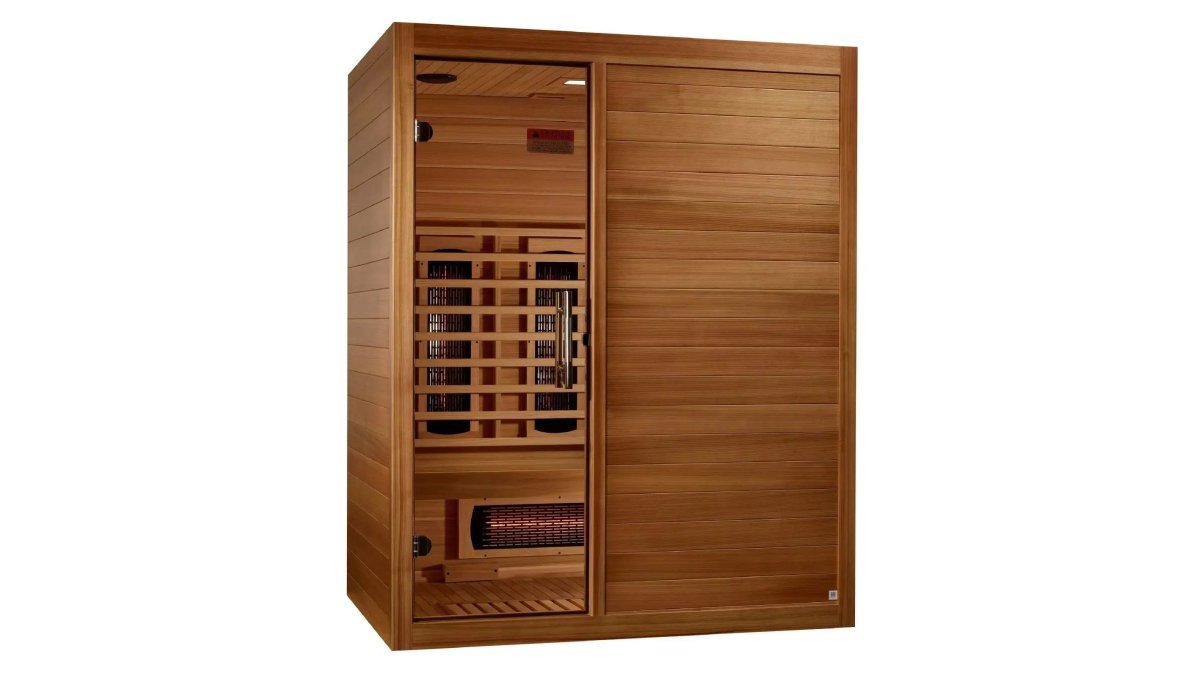
Built from natural Pacific Cedar with carbon far-infrared panels plus near-infrared emitters on all four interior walls, this is the model for a full-spectrum experience without stepping up to the largest cabins. It seats three, includes chromotherapy lighting and Bluetooth audio, and assembles with a no-tools clasp system. The removable bench doubles as floor space for stretching or yoga.
Finnmark FD-2 Full Spectrum 2-Person Home Infrared Sauna
This is the couples' pick, and the construction is where it earns the price: double-walled with non-toxic wool insulation, an antimicrobial Western Canadian Cedar interior, and low EMF levels tested by a NASA award-winning facility. It combines long-wave Carbon 360 panels with UL-listed short-wave Spectrum Plus™ heaters, reaches 170°F in under an hour, and plugs into a standard outlet with no special wiring. The LCD touchscreen and Bluetooth audio round out a package that feels considered.
Thermora Valen Luxury 2-Person Low EMF FAR Infrared Sauna
For the buyer who cares most about how the room feels, the Valen is the standout. Eight millimeters of panoramic tempered glass give it an open, architectural presence, and the 2000W mica carbon plate heating reaches its optimal range in about 10 minutes. It's ETL, CE, and GS certified, adjusts from 65 to 149°F, and includes Bluetooth audio and chromotherapy lighting. If you're building a dedicated wellness room and want the sauna to look like it belongs there, start here.
| Model | Capacity | Heating Type | Max Temp | Best For |
|---|---|---|---|---|
| Maxxus S-Line 3-Person | 3 | Full spectrum | Standard IR range | Full-spectrum value |
| Finnmark FD-2 | 2 | Full spectrum | 170°F | Couples, insulation quality |
| Thermora Valen | 2 | FAR infrared | 149°F | Design-led wellness rooms |
Each is available through Prime Recovery Den, and the difference comes down to how you'll use the space. The FD-2 is the couples' pick. The Valen is for a room you want to show people. The Maxxus S-Line is a versatile option.
Common Concerns and Safety Precautions
Sauna bathing is broadly safe for healthy adults, but the contraindications are real and worth taking seriously.
Skip sauna use, or get clearance from your physician first, if you have unstable angina, recent heart attack or stroke, severe aortic stenosis, or uncontrolled blood pressure. If you take medications that affect blood pressure, heart rate, or sweating, including diuretics and beta blockers, ask your doctor before starting. The FDA guidance on heat-related illness and warning signs is a useful reference for recognizing when heat exposure has gone too far.
Pregnant women should consult a physician before regular sauna use. Anyone with impaired ability to sweat, or with skin conditions aggravated by heat, should do the same.
Practical safety habits matter as much as medical ones:
- Never combine sauna use with alcohol or recreational drugs
- Exit immediately if you feel dizzy, nauseated, or develop a headache
- Cool down gradually rather than jumping into cold water straight from a hot cabin
- Keep the door unblocked and let the cabin ventilate between sessions
- Never sleep in a running sauna
The CDC information on preventing heat-related illness covers the warning signs in more detail, and it's worth a read before your first session rather than after.
Conclusion: Is a Home Sauna Right for You?
The honest verdict: a home sauna is worth it for stress relief if you'll use it three or more times a week, and a poor investment if you won't. Frequency is the whole equation. Wood species, heater type, and lighting are secondary to whether the cabin becomes part of your week.
Where the home version wins decisively is friction. No drive, no locker room, no waiting for a bench. You walk in, sit down, and come out calmer. That proximity turns an occasional treat into a genuine stress-management tool, and it's why owners describe their sauna as the room they'd give up last.
At Prime Recovery Den, we built our sauna collection around that idea: a restorative space should feel like somewhere you want to be, not equipment you schedule. Every cabin we carry is chosen for craftsmanship and atmosphere as much as specification. Free shipping on most orders within the Continental U.S., secure payment processing, and thoughtful customer support mean the only thing left is deciding which corner of your home becomes the quiet one.
Get started with Prime Recovery Den and turn an unused room into the sanctuary you actually retreat to.
Frequently Asked Questions
What are the downsides of having a home sauna?
The main downsides are upfront cost, space requirements, and ongoing maintenance. Home saunas range from $2,499 to $7,999 at Prime Recovery Den, and you'll need a dedicated room or corner. Electrical work may be required, and regular cleaning plus occasional heater checks are necessary. However, for regular users, the convenience and long-term savings often outweigh these drawbacks.
Will a sauna help with stress?
Yes. Sauna bathing triggers a parasympathetic response that lowers cortisol levels and promotes relaxation. The heat also releases endorphins, which improve mood and reduce anxiety. Many users report better sleep and a calmer mind after sessions. For stress relief, consistency matters more than intensity, so short, regular sessions are effective.
What happens after 20 minutes in the sauna?
After 20 minutes, your body has typically reached peak sweating, heart rate is elevated, and vasodilation is at its height. You may feel deeply relaxed but also fatigued. Most experts recommend limiting sessions to 15-20 minutes, especially for beginners. Exceeding this can lead to dehydration or dizziness, so listen to your body and hydrate.
Are infrared saunas better for stress than traditional saunas?
Infrared saunas operate at lower temperatures (110-150°F) and penetrate deeper into tissues, which some users find more comfortable and effective for stress relief. Traditional saunas use higher heat (150-190°F) and humidity. Both trigger relaxation, but infrared models like those from Prime Recovery Den are easier to install indoors and often preferred for home use.
How does heat therapy impact cortisol levels?
Heat therapy activates heat shock proteins and reduces sympathetic nervous system activity, which can lower cortisol. Studies show regular sauna use may blunt cortisol spikes and improve overall stress resilience. The relaxation response also boosts endorphins, creating a calming effect that lasts hours after your session.

Leave a comment
This site is protected by hCaptcha and the hCaptcha Privacy Policy and Terms of Service apply.