

Is Professional Sauna Installation Worth It? 2026 Guide
Table of Contents
- Is Professional Sauna Installation Worth It? The Core Decision
- Average Cost of Home Sauna Installation: What You'll Actually Spend
- Sauna Electrical Requirements NEC and Safety Compliance
- DIY Sauna Kit vs. Custom Build: Installation Paths Compared
- Long-Term ROI and Property Value Impact
- Insurance, Liability, and Warranty Protection
- Site Preparation, Permits, and Building Code Compliance
- Maintenance, Calibration, and Long-Term Care
Last Updated: August 10, 2026
Is Professional Sauna Installation Worth It? The Core Decision
Whether professional sauna installation makes sense depends on your budget, technical comfort, and what you value in the finished product. The core tension is straightforward: DIY kits cost less upfront but demand your time and carry execution risk, while professional installation costs more initially but transfers risk to licensed contractors who carry liability insurance and understand building codes.
Below, we'll walk you through actual costs, safety and compliance issues that matter, and the real difference between DIY and professional approaches. By the end, you'll know whether is professional sauna installation worth it for your home.
Average Cost of Home Sauna Installation: What You'll Actually Spend
The total cost breaks into three categories: the sauna unit itself, labor and installation fees, and permits plus inspections.
Labor and Installation Fees
Installation labor typically represents 30-50% of total project cost. A straightforward prefab sauna in an existing space costs less than a custom build requiring structural modifications, electrical upgrades, or site preparation.
Factors that drive labor costs higher include structural work, electrical upgrades, ventilation system installation, custom framing, and finishing work. Professional installers typically charge hourly rates or flat fees per project. Assembly time for a prefab kit ranges from 16-40 hours depending on complexity. Custom builds take significantly longer, often 80-200+ hours including site prep, framing, electrical, and finishing.
Equipment and Materials
The sauna unit itself is your largest single expense. Prefab kits offer lower entry costs, while custom builds command premium pricing. Cedar wood, the preferred interior material, affects pricing substantially.
Beyond the sauna shell, you'll need a sauna heater, sauna stones, insulation materials, vapor barrier, electrical components, ventilation materials, and finishing materials. Materials alone for a mid-range installation typically account for 40-60% of total project cost.
Permits and Inspections
Building permits typically cost between $200-$800 for a residential sauna project. Inspection fees add another $150-$400. Inspectors verify electrical compliance (NEC standards), structural integrity, ventilation adequacy, and fire safety measures. Skipping permits to save money creates liability exposure: your homeowner's insurance may not cover damage or injury in an unpermitted installation.
Sauna Electrical Requirements NEC and Safety Compliance
Electrical safety is where DIY installations most often fail. The National Electrical Code (NEC) governs residential sauna wiring, and violations create fire risk and liability exposure.
Hardwiring vs. Plug-In Options
Hardwiring means running dedicated electrical circuits directly from your home's breaker panel to the sauna heater. This is the standard for permanent installations and is required by code for heaters drawing more than 50 amps.
Plug-in saunas use standard 240-volt outlets and are suitable only for smaller, lower-power units. They're simpler to install but limit your options for heater size and performance.
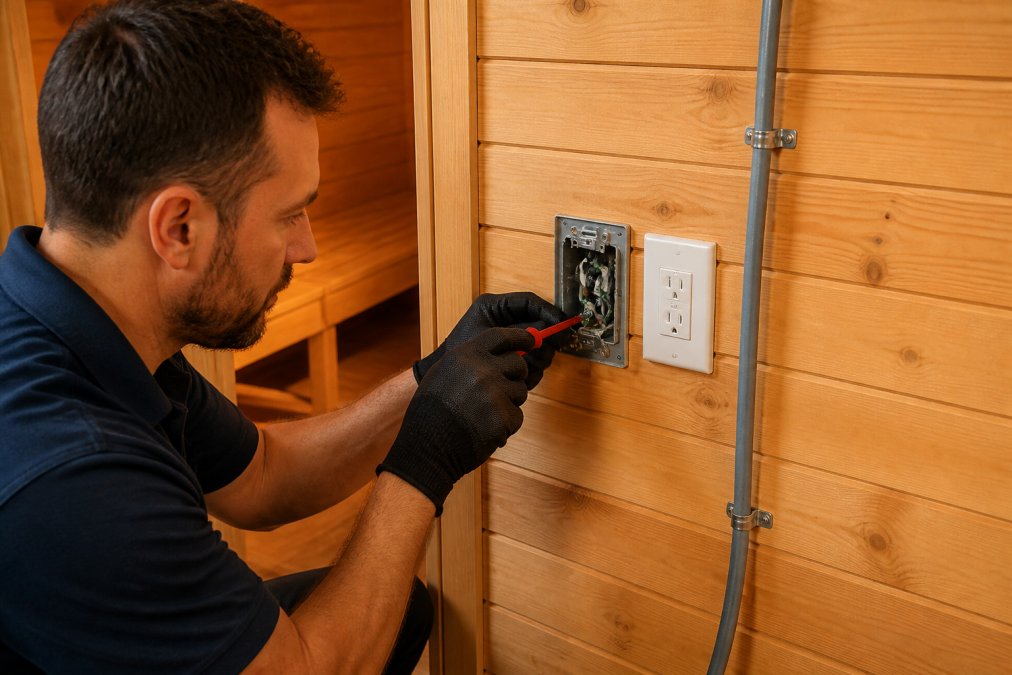
The NEC requires that sauna circuits be protected by a disconnect switch within sight of the sauna. Many homeowners installing DIY miss this requirement entirely.
Ground Fault Circuit Interrupter Protection
A ground fault circuit interrupter (GFCI) is a safety device that cuts power instantly if it detects a ground fault, a dangerous condition where electricity finds an unintended path to ground, often through water or a person. In a sauna environment, where moisture is constant, GFCI protection is non-negotiable.
The NEC mandates GFCI protection for all sauna circuits. This can be achieved through a GFCI breaker in your main panel or through GFCI outlets at the sauna location. Many DIY installers install standard outlets and assume they're safe; they're not.
Professional electricians understand these requirements and verify that your home's electrical service has sufficient capacity. A 240V sauna heater drawing 50-80 amps requires either a new dedicated circuit or confirmation that existing circuits can handle the load.
DIY Sauna Kit vs. Custom Build: Installation Paths Compared
The choice between DIY and custom installation shapes cost, timeline, quality, and your role in the process.
Assembly Time and Complexity
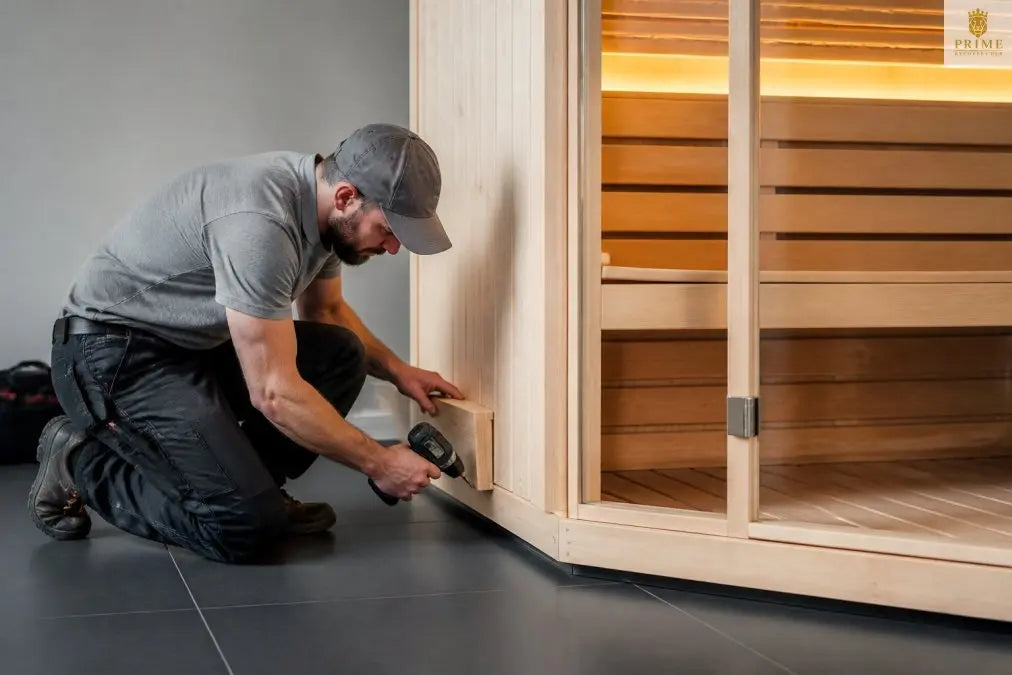
A prefab sauna kit arrives partially assembled. Assembly typically takes 16-40 hours for one person and involves preparing the subfloor, assembling wall panels, installing the door, running electrical connections, installing ventilation, and testing the heater.
Prefab kits reduce complexity because the engineering is done. The risk is assembly errors, misaligned panels, improper insulation, loose connections, that become expensive to fix later.
Custom builds start from scratch. A contractor designs the sauna around your space, sources materials, frames the structure, installs insulation and vapor barrier, finishes interior surfaces, and integrates electrical and ventilation systems. Custom work takes 80-200+ hours and requires coordination across multiple trades.
When DIY Makes Sense
DIY works best when you have moderate carpentry and electrical skills, are installing a small prefab kit in an existing space with no structural modifications, electrical service is adequate and nearby, you have time to research code requirements, and you're comfortable with potential mistakes and their costs.
DIY does NOT make sense when the space requires structural work, electrical upgrades are needed, you lack experience with moisture control and vapor barriers, the project involves custom carpentry, or you're uncertain about code compliance.
Long-Term ROI and Property Value Impact
Homes with well-maintained saunas typically see modest property value increases, roughly 3-8% of the sauna's installed cost reflected in resale value. A $20,000 sauna installation might add $600-$1,600 to your home's appraised value.
However, this assumes professional-grade construction and ongoing maintenance. A poorly built sauna can actually reduce property value by creating liability concerns for future buyers.
The real ROI comes from use. A sauna you actually use for recovery, relaxation, and wellness delivers value that transcends resale price. Professional installation increases the likelihood of long-term use because the sauna works reliably and safely.
Insurance, Liability, and Warranty Protection
Homeowner's insurance typically covers saunas installed to code by licensed contractors. If someone is injured in a professionally installed sauna that meets all safety standards, your insurance is likely to cover the claim. If the sauna was installed without permits or by unlicensed DIY work, the insurer may deny coverage entirely.
Professional contractors carry liability insurance and typically provide warranties on their work. DIY installations come with no warranty. If the heater fails, the door seal leaks, or the electrical system malfunctions, you pay for repairs out of pocket and assume full liability if someone is injured.
Site Preparation, Permits, and Building Code Compliance
Proper site preparation determines whether your sauna lasts 20 years or develops problems within five.
Subfloor and Structural Considerations
A sauna is heavy. A typical prefab unit weighs 1,500-3,000 pounds fully assembled. Your subfloor must support this concentrated load without deflecting.
Building codes require that sauna floors be built on load-bearing surfaces, typically concrete slabs or properly engineered joists. If you're installing in a basement, the concrete floor usually works fine. If you're installing in an upstairs room or above a crawlspace, you may need to reinforce joists or add support beams.
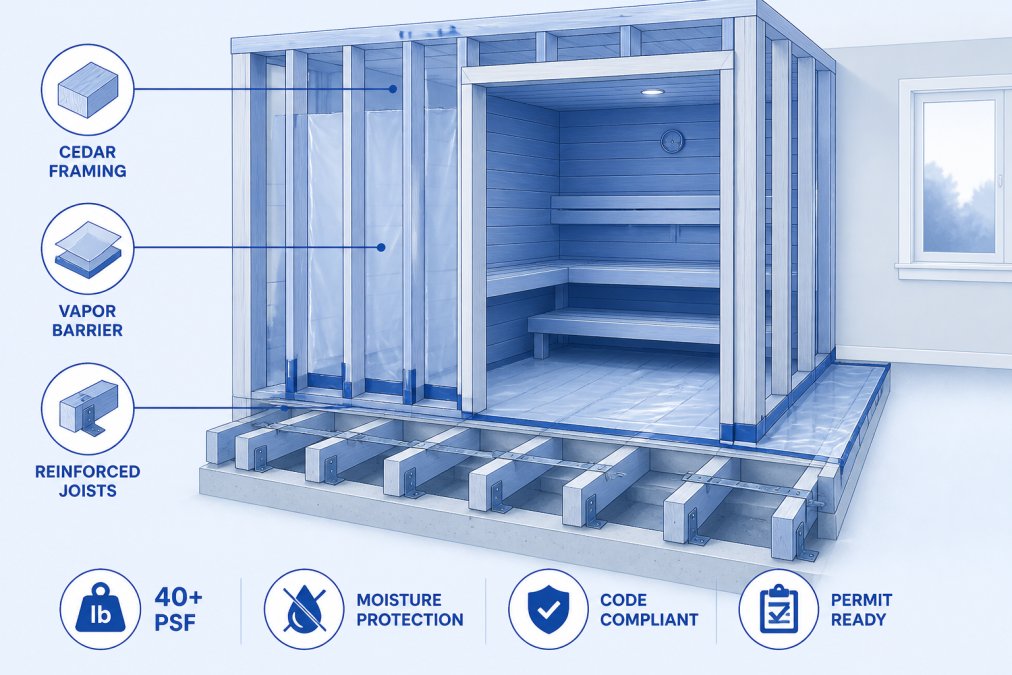
A structural engineer can evaluate your subfloor for $300-$600. Sauna floors should also have adequate drainage, with sloped flooring toward a drain, vapor barrier beneath the sauna, and ventilation to allow air circulation and drying.
Ventilation and Moisture Control
Moisture control separates a sauna that lasts from one that rots from the inside out.
Sauna ventilation works by bringing in fresh air (intake) and exhausting humid air (exhaust). The exhaust duct should run to the outside of the home, not into an attic or crawlspace where moisture can damage framing and insulation.
Code requires that sauna exhaust fans move adequate cubic feet per minute (CFM) based on sauna size. A typical residential sauna needs 50-150 CFM of exhaust capacity. Undersized ventilation leads to moisture accumulation, mold growth, and structural damage.
Vapor barriers, typically polyethylene sheeting installed on walls and ceiling, prevent moisture from migrating into insulation and framing. The barrier must be continuous and sealed at seams. Professional installers understand these requirements and execute them properly.
Maintenance, Calibration, and Long-Term Care
A properly installed sauna requires minimal maintenance, but neglecting it shortens its lifespan and creates safety issues.
Regular maintenance includes weekly cleaning, monthly inspection, quarterly deep cleaning, and annual heater inspection. Sauna stones last 3-5 years before they degrade and lose their ability to retain heat. Replacing stones costs $200-$500.
Temperature calibration ensures your sauna reaches and maintains the correct temperature. If your sauna isn't reaching the expected temperature, a professional can recalibrate or replace the thermostat for $300-$600.
Cedar wood naturally resists rot and requires minimal treatment. Never use varnish or polyurethane inside a sauna; heat and moisture will damage the finish and release fumes.
| Maintenance Task | Frequency | Typical Cost | Impact |
|---|---|---|---|
| Cleaning and inspection | Weekly | $0 (DIY) | Prevents mold, extends wood life |
| Deep cleaning | Quarterly | $0-$100 (DIY) | Maintains hygiene and aesthetics |
| Heater inspection | Annual | $150-$300 | Ensures safety and performance |
| Stone replacement | Every 3-5 years | $200-$500 | Restores heating efficiency |
| Thermostat calibration | As needed | $300-$600 | Maintains temperature accuracy |
| Electrical inspection | Every 2-3 years | $150-$250 | Verifies NEC compliance, prevents hazards |
Frequently Asked Questions
How much does professional sauna installation cost?
Professional sauna installation costs vary based on sauna type, size, electrical load requirements, and site conditions. Labor rates depend on your region and contractor expertise. Permits, inspections, and structural preparation add to the total. For an accurate estimate, contact a licensed installer who can assess your specific space and electrical infrastructure. Prime Recovery Den's support team can help connect you with qualified professionals in your area.
What are the sauna electrical requirements according to the NEC?
The National Electrical Code (NEC) requires saunas to have dedicated circuits with proper ground fault circuit interrupter (GFCI) protection. Hardwired saunas typically need a 240-volt circuit with appropriate amperage capacity based on the heater's electrical load. The exact specifications depend on your sauna's wattage and your home's electrical panel capacity. A licensed electrician must verify your home meets these requirements and install the circuit safely to ensure compliance and safety.
Should I choose a DIY sauna kit or hire someone for a custom build?
DIY sauna kits offer lower upfront costs and faster installation for those with basic carpentry skills, but they require careful attention to electrical safety and building codes. Custom builds provide tailored design, professional-grade materials like kiln-dried cedar, and expert site preparation. If your space has structural challenges, unique dimensions, or complex electrical needs, professional installation protects your investment and ensures long-term durability and safety compliance.
Does professional sauna installation increase my home's resale value?
A professionally installed sauna can enhance your home's appeal to buyers seeking wellness amenities, particularly in markets where home recovery spaces are valued. However, resale value depends on installation quality, design integration, and local market demand. Proper permits, code compliance, and quality craftsmanship protect your investment and give future buyers confidence in the installation's safety and longevity.
The decision to hire a professional for sauna installation ultimately comes down to risk tolerance and the value you place on reliability. A professionally installed sauna from Prime Recovery Den, built to code, backed by warranty, and properly maintained, delivers years of safe, consistent performance. It's an investment in both your home's value and your long-term wellness. For most homeowners, that peace of mind is worth the upfront cost.


Leave a comment
This site is protected by hCaptcha and the hCaptcha Privacy Policy and Terms of Service apply.