

How to Select a Luxury Billiard Table for Your Home
Last Updated: October 22, 2026
Quick Summary
Selecting a luxury billiard table for your home starts with understanding your space and choosing a slate playing surface, which delivers consistent ball roll and rebound that separates serious tables from budget alternatives. An 8-foot slate table with solid hardwood frame, K66 cushions, and professional installation creates a tournament-grade playing experience that will serve reliably for decades.
- An 8-foot table is the standard for residential game rooms and requires approximately 13 feet 4 inches of length and 17 feet of width for comfortable play
- One-inch slate is the professional standard; thinner slate flexes under impact and creates inconsistent ball response
- K66 rubber cushions and worsted wool blend cloth are industry standards that ensure predictable rebound and durability
- Professional installation is essential to properly level the slate and seam the joints for accurate playability
- A quality slate table retains 40-60% of its original value and will perform beautifully for 20+ years with routine maintenance
Table of Contents
- Understanding Your Space: A Pool Table Size Guide
- Measuring Your Room: Billiard Table Room Dimensions and Cue Clearance
- Playing Surface Quality: Why a Slate Pool Table Matters
- Frame, Legs, and Stability: Building a Solid Foundation
- Cushions, Cloth, and Playing Performance
- Pool Table Installation and Maintenance for Long-Term Enjoyment
- Style, Finish, and Aesthetic Integration
- Total Cost of Ownership and Warranty Considerations
- Frequently Asked Questions
Understanding Your Space: A Pool Table Size Guide
Selecting a luxury billiard table for your home starts with understanding what size actually works for your space and playing style. An 8-foot table is the standard for most residential game rooms, it's the size used in professional tournaments and offers enough challenge for serious players without consuming an entire room. Seven-foot tables exist for smaller spaces, but they're less common in the luxury market. Nine and 10-foot tables demand dedicated rooms and are rarely installed in homes unless you're building a serious billiards lounge.
The choice between these sizes determines everything that follows: room dimensions, cue clearance, installation logistics, and ultimately whether you'll actually use the table regularly. Most people underestimate how much space a billiard table truly needs.
The standard 8-foot table measures roughly 88 inches long and 44 inches wide. But those dimensions are just the playing surface. You need to account for cue length, player positioning, and comfortable movement around the entire table.

Measuring Your Room: Billiard Table Room Dimensions and Cue Clearance
Before you commit to any luxury billiard table, measure your room carefully. This is where most buyers make costly mistakes, they see a table online, fall in love with the design, and only discover after delivery that it doesn't fit their space properly.
For an 8-foot table with standard 58-inch cues, you need approximately 13 feet 4 inches of length and 17 feet of width as your minimum room footprint. This accounts for roughly 2.5 feet of clearance on each side of the table, enough space to stand comfortably and execute shots without your cue hitting walls or furniture.
If your room is tighter than that, a 7-foot table might be necessary, though it changes the playing experience significantly. Measure doorways and hallways too. An 8-foot slate table doesn't disassemble easily during transport. You need clear passage from your entry point to the final location.
The height of your ceiling also matters. Eight feet is the standard table height, and you'll want at least 9 feet of vertical clearance above the felt to avoid cue contact on jump shots. Low ceilings don't just limit technique, they make the room feel cramped around an already substantial piece of furniture.
Playing Surface Quality: Why a Slate Pool Table Matters
The playing surface is where a luxury billiard table separates itself from mid-range alternatives. A slate pool table delivers consistent, predictable ball roll and rebound that simply cannot be matched by composite materials. This consistency is what serious players notice immediately.

Slate is a naturally occurring metamorphic rock that, when properly quarried and finished, creates an incredibly flat, dense playing surface. The material is heavy, a three-piece slate bed for an 8-foot table weighs roughly 500 to 600 pounds, but that weight translates directly into stability and vibration dampening. When you strike a ball, the energy transfers cleanly into the felt and cushions rather than dissipating through flex in the playing surface.
Slate Thickness and Construction
Professional and luxury tables use 1-inch slate, which is the standard thickness for serious play. Some budget tables use three-quarter inch or even half-inch slate, and the difference in playability is immediately obvious. Thinner slate flexes slightly under impact, causing inconsistent ball response and dead spots on the surface.
The slate typically comes in three pieces for an 8-foot table. These pieces are carefully seamed together and leveled during installation. Proper seaming means the joints are nearly imperceptible during play, the ball rolls across them without noticeable deflection. Poor seaming creates ridges that throw off shots and frustrate players.
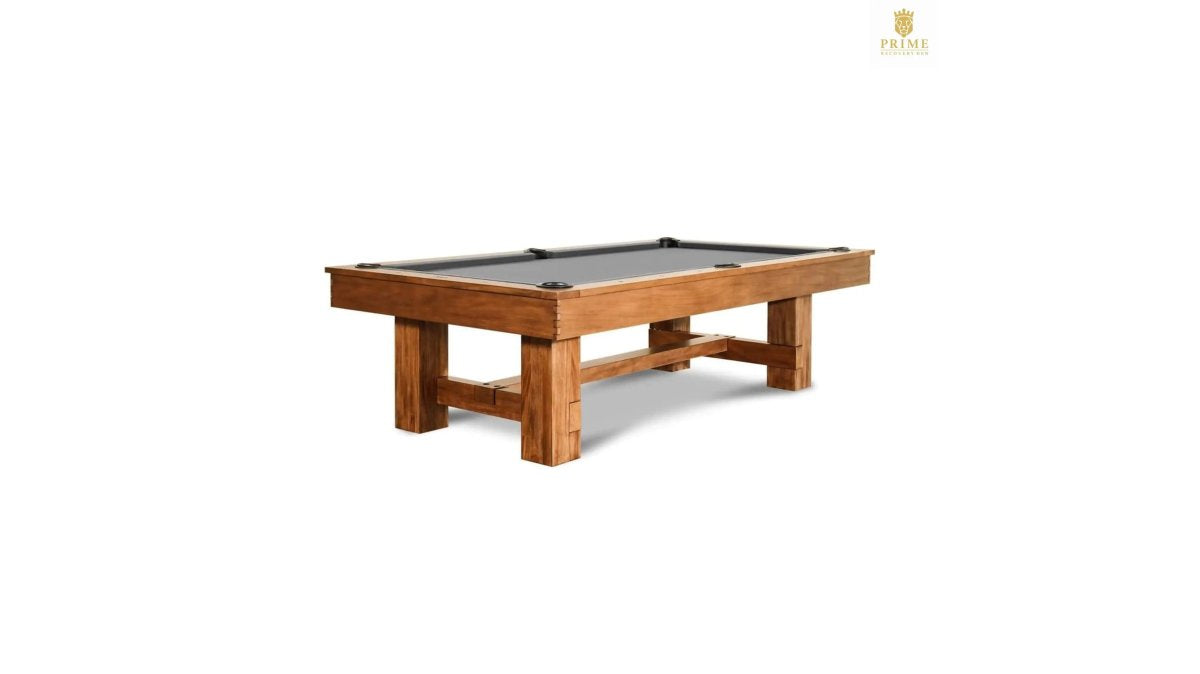
A luxury billiard table like the 8 Ft Slate Pool Table with 1-Inch BCA Slate and Acacia Wood from Prime Recovery Den uses BCA-standard slate with authentic K66 cushions, ensuring tournament-grade playability in your home.
Slate vs. Non-Slate Options
Non-slate alternatives, typically engineered wood or composite materials, cost significantly less upfront. They're lighter, easier to move, and require less maintenance. But they don't play like slate. The surface is never quite as flat, the rebound is softer and less predictable, and over time, these materials can warp or develop dead spots.
If you're building a luxury game room and plan to keep the table for decades, slate is the only choice. If you're furnishing a casual game space for occasional play, a high-quality non-slate table might serve you adequately. The distinction comes down to your commitment to the game and how often you'll actually play.
Frame, Legs, and Stability: Building a Solid Foundation
The frame and legs carry the entire weight of the slate and support the dynamic forces created during play.
Luxury tables use solid hardwood frames, typically oak, maple, or acacia, rather than plywood or particle board. Hardwood is denser, more stable across temperature and humidity changes, and ages beautifully. The wood selection matters aesthetically too.
The legs must be substantial. Thin, decorative legs might look elegant but won't provide adequate support. A proper 8-foot slate table needs legs that are at least 3 to 4 inches thick and braced internally with cross-supports.
Leveling is critical. Even a slight tilt, less than one-eighth inch over the entire table, affects ball roll and shot accuracy. Quality tables come with adjustable feet that allow fine-tuning after installation.
Cushions, Cloth, and Playing Performance
The cushions (also called rails or bumpers) and cloth work together to define how the ball behaves during play. These components directly affect shot speed, spin, and rebound.
K66 rubber cushions are the industry standard for serious play. They're vulcanized rubber compounds engineered to provide consistent, predictable rebound across the entire rail.
8 Ft Slate Pool Table, 1-Inch BCA Slate, Acacia Wood, K66 Cushions →
The cloth covering the slate is typically a worsted wool blend, most commonly championship green or championship blue. Worsted wool is tightly woven and durable, resisting pilling and fading better than cheaper blends.
Different cloth colors affect visibility and aesthetics. Championship green is traditional and reduces eye strain during extended play. Championship blue offers a modern alternative while maintaining excellent playability.
The cloth needs regular brushing to maintain the nap and keep the surface clean. Dust and chalk residue accumulate and affect ball roll.
Pool Table Installation and Maintenance for Long-Term Enjoyment
Installation is where many buyers stumble. A slate table isn't furniture you assemble yourself. The slate must be carefully positioned, seamed, and leveled by someone with proper tools and experience.
Prime Recovery Den offers free standard shipping to the contiguous United States, with delivery typically arriving within 5-10 business days. The table arrives disassembled, and professional installation is strongly recommended. The installer will position the slate, seam the joints, apply leveling compound if needed, and verify flatness with precision instruments.
Maintenance is straightforward but consistent. Brush the cloth regularly to maintain the nap. Use a damp cloth to clean the slate surface periodically, but never soak it, excess moisture can damage the wood frame. Check the leveling annually, especially if your home experiences significant temperature or humidity swings.
Style, Finish, and Aesthetic Integration
A luxury billiard table is a statement piece. It occupies significant visual real estate in your game room, so the design must align with your overall aesthetic and the room's architectural character.
Traditional designs feature ornate leg details, rich wood finishes, and classic proportions. These tables evoke the elegance of historic billiard halls and suit period homes or rooms with traditional décor.
Modern designs emphasize clean lines, minimalist leg profiles, and contemporary finishes. The 8 Ft Pool Table with Automatic Ball Return and Green Felt from Prime Recovery Den offers this aesthetic, a dark brown finish with chrome-plated corners that feels current without sacrificing playability.

Wood species and stain color set the tone. Acacia provides warm, honey-toned hues. Walnut delivers deeper, more dramatic coloring. Oak offers lighter, more traditional warmth. Match your table's wood species to other furnishings in the room for visual coherence.
The felt color also affects the room's atmosphere. Championship green is timeless and traditional. Championship blue feels more contemporary. Red felt makes a bold statement and works in rooms with confident color schemes.
Total Cost of Ownership and Warranty Considerations
The purchase price is just the beginning. A complete understanding of total cost of ownership includes delivery, installation, maintenance, and eventual repairs or restoration.
A premium slate table like the 8 Ft Slate Pool Table with 1-Inch BCA Slate and Acacia Wood starts at $4,999.97.
Installation costs vary by region but typically run $200 to $500 for professional setup. This is non-negotiable for slate tables.
Maintenance expenses are modest: occasional brush replacement, annual leveling checks, and eventual cloth or cushion replacement. Budget $50-100 annually for routine care.
Warranty coverage matters. Prime Recovery Den provides a 1-year warranty for workmanship defects, covering frame construction, seaming, and structural issues.
Resale value is worth considering.
Choosing a luxury billiard table transforms how you experience your home.
Frequently Asked Questions
How much room do you need around a billiard table?
For a standard 8-foot luxury billiard table with 58-inch cues, allow approximately 5 feet of clearance on every side. This means your room should be at least 13 feet 4 inches long and 17 feet wide for comfortable play. Measure doorways and hallways during delivery planning to ensure the table can be moved into position without damage. A level floor is essential; use adjustable feet to fine-tune the playing surface once installed.
What is the difference between a slate and a non-slate pool table?
Slate pool tables feature a three-piece, 1-inch BCA-standard slate playing surface that provides a perfectly level, durable surface with consistent ball response and accurate rebounds. Non-slate tables use alternative materials that may be lighter and less expensive but typically don't match slate's precision or longevity. A slate pool table like Prime Recovery Den's 8 Ft Slate Pool Table with K66 Cushions delivers the playing performance serious players expect, while feeling more refined and built to last decades with proper maintenance.
What features make a billiard table suitable for regular play?
Look for K66 rubber cushions that provide crisp, predictable rebounds, a solid frame (native acacia wood is ideal), and genuine leather drop pockets. The playing surface must be level and consistent; slate is the gold standard. Quality cushions and felt directly affect shot control and ball response. Prime Recovery Den's slate and non-slate options both include these performance features, ensuring your table handles frequent play without degrading.
How do you choose the right billiard table size for a home?
Standard home tables are 8 feet long, striking a balance between authentic play and reasonable space requirements. Measure your room first, an 8-foot table needs roughly 13 feet 4 inches of length and 17 feet of width with standard cues. Consider your players' skill level and how often you'll host games. An 8-foot slate table from Prime Recovery Den creates a sophisticated centerpiece that encourages regular play and makes your space feel like a true game room sanctuary.

Leave a comment
This site is protected by hCaptcha and the hCaptcha Privacy Policy and Terms of Service apply.